At What Temperature Does Water Freeze?
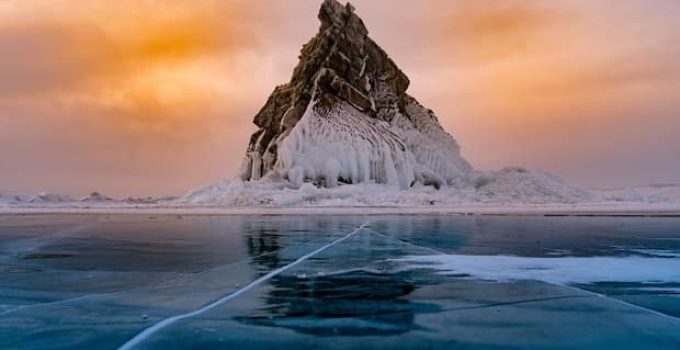
Answer at a Glance: At sea level, water freezes at 32°F, 0°C, and 273°K. The freezing point of water is affected by the purity of the water and, to a lesser degree, atmospheric pressure.
Dig Deeper
- Will Additives In Water Change Its Freezing Point?
- How Does Atmospheric Pressure Affect the Freezing Point?
- At What Temperature Does Ocean Water Freeze?
- Why Don’t All Oceans Freeze in the Winter?
- Glossary of Terms
- References
Will Additives In Water Change Its Freezing Point?

Additives in water can lower its freezing point, a phenomenon known as freezing point depression. When you add a solute (for example, salt) to a solvent (for example, water), the solvent’s freezing point decreases. This occurs because the newly created solution will undergo physical and chemical changes. In chemistry, these changes are referred to as colligative properties. The new freezing point will depend on the number of new particles added in relation to the number of solvent molecules present in the new solution. [1]
For example, a 10% salt solution will lower the freezing point of water to 20°F (-6°C) [2]
How Does Atmospheric Pressure Affect the Freezing Point?

Atmospheric pressure is the pressure exerted by the atmosphere at the Earth’s surface. It has a mean value of one atmosphere at sea level, reducing with increasing altitudes. [3]
Atmospheric pressure plays a small role in the temperature at which water will freeze. At higher elevations, as the atmospheric pressure decreases, the freezing point of water will rise slightly. At lower elevations, the pressure increases, resulting in a lower freezing point. [4]
According to the US Department of Energy’s Office of Science, the effect is minimal as the freezing point of water only rises one-hundredth of a degree per atmosphere of decrease in pressure. [5]
At What Temperature Does Ocean Water Freeze?
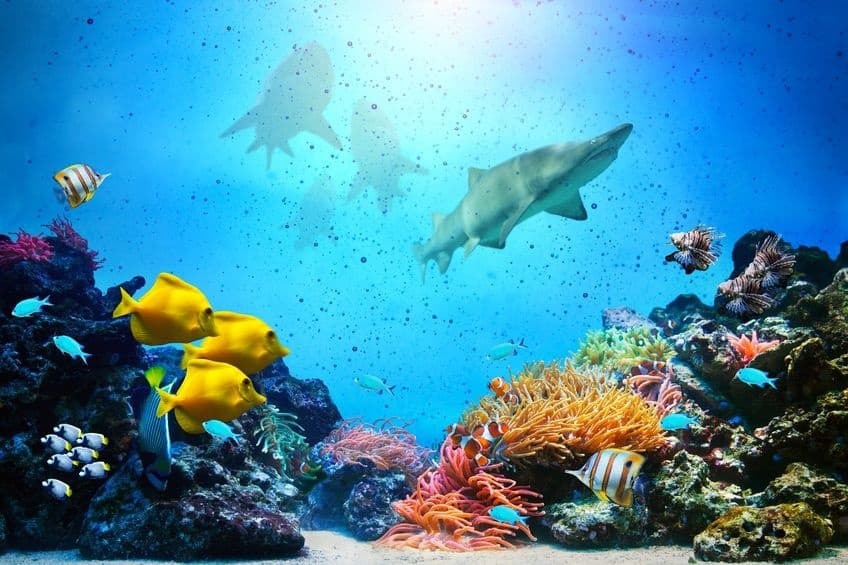
Ocean water freezes at 28.4°F (-2°C).
Ocean water freezes at a lower temperature than freshwater due to its salt content, which interferes with the water’s ability to form ice. Looking at how ice is formed will help clarify why adding salt or any solvent requires a lower temperature to freeze. [6]
When water is exposed to low temperatures, the molecules in motion begin to slow down, making it easier for the molecules to share electrons. As more and more pair up, they begin to form hexagonal structures that interlock, forming ice. With the addition of salt to this process, the salt particles become intertwined with the water molecules, interfering with their ability to share electrons and interlock. When the ice ultimately freezes at a lower temperature, it expels the salt. [7]
Why Don’t All Oceans Freeze in the Winter?
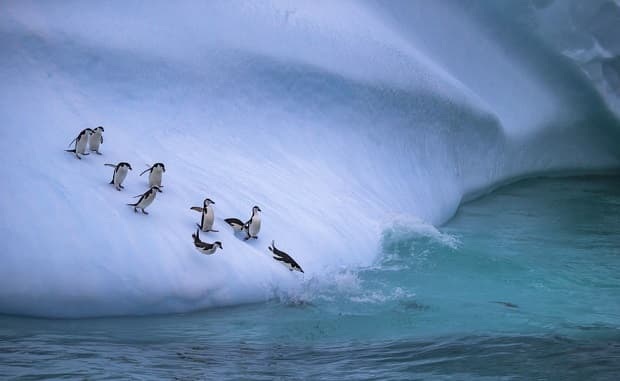
First, it’s important to note that some oceans freeze under the right climatic conditions, such as those in the Arctic and Antarctica. In the Northern Hemisphere, oceans form ice as far south as Bohai Bay, China. [8]
If oceans do freeze, as is demonstrated in the Arctic and Antarctic, why don’t all oceans freeze like lakes? The actual science behind the answer involves a variety of complex processes far beyond the scope of this article. The sheer volume and ocean currents can partially be identified as causes at its most basic level.
It takes an extended period of frozen temperatures to cool a heated water mass to the freezing point. A puddle will freeze before a lake, which will freeze before an ocean due to its sheer mass. New England, for example, has cold weather, but not cold enough for an extended period to form an ice layer on its oceans. On the other hand, the Arctic has long winters with an average temperature of -40°F, capable of producing ice. [9]
Ocean currents also play a role in keeping ocean water from freezing. The movement and the warmer waters introduced to the colder waters inhibit ice from forming.
Glossary of Terms

Colligative Properties: Colligative properties of solutions are properties that depend upon the concentration of solute molecules or ions but not upon the identity of the solute. Colligative properties include freezing point depression, boiling point elevation, vapor pressure lowering, and osmotic pressure.
GSU-Hyperphysics
Freezing Point Depression: Describes the process in which adding a solute to a solvent decreases the solvent’s freezing point. Examples include salt in water, alcohol in water, or mixing two solids, such as impurities in a finely powdered drug.
Wikipedia.com
Solute: substance dissolved in a solution.
Solvent: a substance that dissolves another to form a solution.
Solution: a homogeneous, molecular mixture of two or more substances.
References
- [1] University of California-Davis – “Freezing Point Depression”
- [2] Georgia State University – “Freezing Point Depression in Solutions.”
- [3] The Free Dictionary – “Atmospheric Pressure.”
- [4] UNSW School of Physics – “Freezing point depression and boiling point elevation: the effects of solutes and of pressure.”
- [5] US Department of Energy-Office of Science – “Altitude Freezing.”
- [6] National Oceanic and Atmospheric Administration – “Can the ocean freeze?.”
- [7] University of Maine-Aquarius – “Can Salt Water Freeze.”
- [8] National Snow and Ice Data Center – “All About Sea Ice.”
- [9] Woods Hole Oceanographic Institute – “Polar Discovery: Comparing the Poles: Weather.”
Related Products
As an Amazon affiliate we may earn from qualifying purchases


The Freezing- Point, Boiling – Point and Conductivity Methods
by Harry C Jones