How Do Ants Communicate?
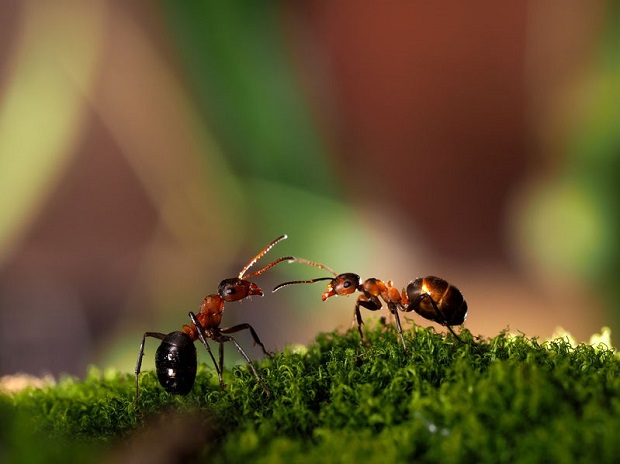
Ants communicate through their senses and through airborne chemicals known as pheromones. It is important for social insects like ants to have the ability to communicate to ensure the safety of their colony and to protect their very existence. Communicating with one another as a colony facilitates a quick response to changes in their surroundings necessary for survival.
Pheromones
Ants communicate through their senses and through airborne chemicals known as pheromones. Pheromones are chemical substances that are secreted externally that influence the behavior of other members of their species. Ants utilize pheromones for a variety of communication circumstances, including mate calling and kin recognition.
Alarm Pheromone
Ants send out an alarm pheromone in cases of distress that function to identify an enemy or alert the other members of the colony to defend the nest. Depending on the species and the environmental conditions, the alarm pheromone can be detected by other ants in the colony from four to ten centimeters away.
Foraging Communication/Trail Setting
Pheromones are an important part of the food-gathering process for ants. Once an ant finds a renewable food source, it heads back to the nest, leaving behind a pheromone trail that will direct other ants in the colony to the food source. The trail will continue to be marked until the food source is depleted or the colony has identified a more profitable source.
Though this method of foraging communication seems as simple as a breadcrumb trail, it is actually highly evolved and can be significant in regulating colony food collection activities, retaining the memory of past food sources, and helping in selecting locations of differing profitability.
Resources
“Communication in Ants.” Current Biology 16.5 (2006): 0. Print.
“Insect Communication.” General Entomology ENT 425. North Carolina State University, n.d. Web. 13 June 2011. www.cals.ncsu.edu/course/ent425/tutorial/Communication/index.html