
Gabrielle Marks | Reviewed: 6/13/2025
What Do Bats Eat?
Answer at a Glance: The dietary habits of bats are as diverse as the species themselves. While 60-70% of bats are insectivores, feeding on insects, beetles, and gnats, some species have a taste for fruit, nectar, and pollen. And then, there are the carnivorous few, who feed on a variety of vertebrates, including rodents, frogs, birds, and fish.
Insectivorous Bats

Insectivorous bats eat insects. Nearly 70% of all bat species are insectivores, feeding primarily on insects. In the United States alone, of the 49 bat species, 45 are insectivores. [1][2]
As nocturnal predators, bats play a crucial role in regulating insect populations. They feed on a variety of insects that fly at night, including gnats, mayflies, moths, crickets, beetles, flies, and even wasps. Their favorite prey, mosquitoes, are a significant nuisance to humans, making the bat an essential ally. A single bat can consume 1,200 mosquitoes in an hour, a remarkable feat that underscores their ecological significance. [3]
How Insectivorous Bats Capture Their Prey
Bats employ a range of methods to capture their prey, showcasing their adaptability and resourcefulness. Smaller insects are often eaten right out of the air, while larger flying insects are pulled in by the wing and dropped into the interfemoral membrane, a flap of skin between the legs used for flight and food captivity. Larger insects commonly found on the ground, such as grasshoppers and beetles, are frequently snatched up by the bat’s feet. [4]
Insectivorous Bat Species Examples
The National Park Service lists the following as insectivorous bat species in Arizona:
- Big brown bat
- California leaf-nosed bat
- California myotis bat
- Cave myotis bat
- Fringed myotis bat
- Hoary bat
- Long-legged myotis bat
- Mexican free-tailed bat
- Pallid bat
- Pocketed free-tailed bat
- Silver-haired bat
- Southwestern myotis bat
- Townsend’s bit-eared bat
- Western pipistrelle bat
- Western red bat
- Western small-footed myotis bat
- Yuma myotis bat
Photos of all of the above insectivorous bats.
Carnivorous Bats

Carnivorous bats eat meat. Less than one percent of all bat species are carnivorous. Depending on the species, they eat a variety of vertebrates, including rodents, birds, fish, frogs, and a range of arthropods, as well as blood. [5]
Rodents etc. The false vampire bat is one example of a carnivorous species. These bats feed on a wide range of prey, including rodents, frogs, fish, lizards, insects, spiders, and birds. Some species even eat other bats. [6]
Frogs. Another carnivorous bat is the frog-eating bat, which has the ability to discriminate between frog calls to distinguish poisonous from non-poisonous species. [7]
Fish. Two bat species are specialized fishers. The greater bulldog bat and the fish-eating myotis float over the top of the water and use their echolocation to find fish near the surface, which they grab with their sharp claws. [8]
Blood. The intimidating-looking vampire bat is the only mammal that feeds exclusively on blood. These nocturnal feeders primarily prey on livestock but have also been known to feed on humans. Unlike the theatrical vampires, these bats don’t drink enough blood to harm their victims, but their bite can result in disease and infection. [9]
How Do Carnivorous Bats Capture Their Prey?
Scientists have discovered that carnivorous bats are bigger than non-meat-eating bats. They also tend to have longer snouts, which enable them ty to quickly close their jaws and snap down on fleeing prey. [10]
Vegetarian Bats

Some species of bats, such as the fruit bat, eat fruits, nectar, and pollen and are an essential part of the pollination and seed dispersal of their food source. [11]
Bats Feed at Night
Bats sleep during the day and emerge at night to feed. They generally begin to stir as dusk sets in and will emerge after dark to feed. They will feed for a few hours and then return to the roost for rest. Many will reemerge for a second feeding before daybreak. [12]
References
- [1] Arizona State College of Agriculture and Life Sciences – Cooperative Extension – “Bats.”
- [2] United States Geological Survey (USGS) – “Ecology of Insect-eating Bats.”
- [3] Nature.com – “10 Fun Bat Facts.”
- [4][12] Smithsonian Institution – “Bat Facts.”
- [5] French, Barbara. “False Vampires and Other Carnivores.” BATS Magazine 15.2 (1997): 1. Print.
- [6] Animal Diversity Web – University of Michigan – Museum of Zoology – “Megadermatidae.”
- [7] Page, Rachel A, and Michael J Ryan. “Flexibility in assessment of prey cues: frog-eating bats and frog calls.” Proceedings. Biological sciences vol. 272,1565 (2005): 841-7. doi:10.1098/rspb.2004.2998
- [8] Bat Conservation International – “Fishing Bats.”
- [9] Texas Tech University Departments – “Vampire Bats Exhibition.”
- [10] Phys.org – “Study Reveals Traits and Evolutionary History of Carnivorous Bats.”
- [11] United States Geological Survey (USGS) – “What Do Bats Eat?”
Related Products
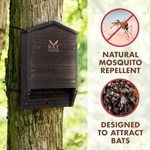
Bat House for Outdoors – 2 Large Chambers Bat Box for Outside & Tree – Black
Bats are vital as pollinators & seed dispensers, which makes them crucial for our ecosystems and functional economic agricultures. Set up a bat house to support these versatile creatures.